Vector Database Comparison 2026: Pinecone vs Weaviate vs Chroma vs pgvector

Vector Database Comparison 2026: Pinecone vs Weaviate vs Chroma vs pgvector

Picking the wrong vector database will cost you more than you expect — in migration pain, latency surprises, or bills that scale faster than your users. After testing Pinecone, Weaviate, Chroma, and pgvector across real RAG workloads in 2026, the short answer is: Pinecone for zero-ops production, Weaviate for hybrid search, pgvector if you already run Postgres, and Chroma for prototyping. What Is a Vector Database and Why Does It Matter in 2026? A vector database is a purpose-built data store that indexes and retrieves high-dimensional numerical vectors — the mathematical representations that AI models use to encode the meaning of text, images, audio, and video. Unlike relational databases that match exact values, vector databases find “nearest neighbors” using distance metrics like cosine similarity or dot product. In 2026, they are the backbone of every retrieval-augmented generation (RAG) system, semantic search engine, and AI recommendation pipeline. The vector database market is projected to reach $5.6 billion in 2026 with a 17% CAGR, driven by the explosion of LLM-powered applications requiring real-time context retrieval. Choosing the right one is not a minor infrastructure decision: the wrong pick can mean 10x higher latency, 5x higher cost, or a painful migration when your index grows from 100K to 100M vectors. The four databases in this comparison — Pinecone, Weaviate, Chroma, and pgvector — cover the full spectrum from zero-ops managed SaaS to embedded Python libraries to PostgreSQL extensions. ...

April 15, 2026 · 11 min · baeseokjae
Advanced Prompt Engineering Techniques Every Developer Should Know in 2026

Advanced Prompt Engineering Techniques Every Developer Should Know in 2026

Prompt engineering in 2026 is not the same discipline you learned two years ago. The core principle—communicate intent precisely to a language model—hasn’t changed, but the mechanisms, the economics, and the tooling have shifted enough that techniques that worked in 2023 will actively harm your results with today’s models. The shortest useful answer: stop writing “Let’s think step by step.” That instruction is now counterproductive for frontier reasoning models, which already perform internal chain-of-thought through dedicated reasoning tokens. Instead, control reasoning depth via API parameters, structure your input to match each model’s preferred format, and use automated compilation tools like DSPy 3.0 to remove manual prompt iteration entirely. The rest of this guide covers how to do all of that in detail. ...

April 15, 2026 · 13 min · baeseokjae
Fine-Tuning vs RAG vs Prompt Engineering: When to Use Which in 2026

Fine-Tuning vs RAG vs Prompt Engineering: When to Use Which in 2026

Picking the wrong LLM customization strategy will cost you months of work and thousands in wasted compute. Fine-tuning, RAG, and prompt engineering solve fundamentally different problems — and in 2026, with 73% of enterprises now running some form of customized LLM, choosing the right tool from the start separates teams that ship in days from teams that rebuild for months. What Is Prompt Engineering — and When Does It Win? Prompt engineering is the practice of crafting input instructions that guide a pre-trained LLM to produce the desired output without modifying any model weights or external retrieval. It requires no infrastructure, no training data, and no deployment pipeline — you change text, and results change immediately. This makes it the fastest path from idea to prototype: a capable engineer can design, test, and deploy a production prompt in hours. In 2026, prompt engineering techniques like chain-of-thought (CoT), few-shot examples, role prompting, and structured output constraints are mature and well-documented. The practical ceiling is the context window: GPT-4o supports 128K tokens, Claude 3.7 Sonnet supports 200K, and Gemini 1.5 Pro reaches 1M — meaning most knowledge that fits within those limits can be injected at inference time rather than requiring fine-tuning or retrieval. Start with prompt engineering unless you have a specific reason not to. ...

April 14, 2026 · 16 min · baeseokjae
Vibe Coding Explained: The Complete Developer Guide for 2026

Vibe Coding Explained: The Complete Developer Guide for 2026

Vibe coding is a natural-language-driven approach to software development where developers describe what they want in plain English and AI tools generate the actual code. In 2026, 41% of all code written globally is AI-generated, and 92% of US developers use AI coding tools daily — making vibe coding not a curiosity but the dominant mode of software creation. What Is Vibe Coding? Vibe coding is a software development methodology where a human provides high-level intent — in natural language, sketches, or structured briefs — and an AI model generates, refines, and iterates on working code. The term was coined by Andrej Karpathy in early 2025 and named Word of the Year by Collins Dictionary for 2025. Unlike traditional coding where you write every line, vibe coding treats the developer as an architect and the AI as the implementation engine. The vibe coding market reached $4.7 billion in 2026, with over 138 tools available and 63% of users being non-developers (Taskade’s State of Vibe Coding 2026). The core shift: you are no longer the typist. You are the person who knows what to build, why to build it, and how to evaluate whether the AI built it correctly. Senior engineers report 3-10x productivity gains on routine tasks using vibe coding workflows. The defining characteristic is that you never need to memorize syntax — you need to master intent. ...

April 14, 2026 · 18 min · baeseokjae
Claude Code vs GitHub Copilot 2026

Claude Code vs GitHub Copilot 2026: Terminal Agent vs IDE Assistant

Claude Code and GitHub Copilot solve the same problem—writing better code faster—but they do it in fundamentally different ways. Claude Code is an autonomous terminal agent that operates on your entire codebase; Copilot is an IDE extension that sits beside you as you type. Choosing between them depends on how you actually work, not which has the longer feature list. What Is Claude Code and How Does It Work? Claude Code is Anthropic’s CLI-based coding agent. You run it from the terminal with claude and it can read files, run tests, execute shell commands, and make multi-file edits—all from a conversation loop. There’s no IDE plugin required. ...

April 14, 2026 · 10 min · baeseokjae
AI Agent Deployment Infrastructure 2026

AI Agent Deployment Infrastructure 2026: Ampere.sh vs E2B vs Modal vs Northflank

If you need an always-on managed assistant, Ampere.sh is the fastest path; if you need programmable, isolated coding workspaces, E2B usually fits better; if you need serverless GPU workflows plus sandbox primitives, Modal is often the best platform; and if you need BYOC, SOC 2 Type 2 posture, and one control plane for jobs, workers, APIs, and sandboxes, Northflank typically wins. I learned this the hard way while comparing these platforms for teams that moved from demo-only agent projects to production. The failure pattern is always the same: teams buy for one axis (for example “runs code in sandbox”), then discover they also need persistence, compliance, observability, or GPU jobs and the original choice breaks. This guide is written to prevent that category error. ...

April 13, 2026 · 11 min · baeseokjae
AI Agent Deployment Infrastructure 2026

AI Agent Deployment Infrastructure 2026: Ampere.sh, E2B, Northflank, and Modal Compared

AI agent deployment infrastructure in 2026 is not one category. Ampere.sh, E2B, Northflank, and Modal solve different problems: managed agent hosting, secure code execution, full-stack production infrastructure, and Python/GPU serverless compute. The right shortlist depends on what your agent actually does after the model call returns. I’ve found that teams get into trouble when they compare these platforms as if they were four interchangeable “agent sandbox” vendors. They are not. A personal OpenClaw agent that needs to stay online in a managed product has little in common with a coding agent that needs Firecracker isolation for 20 concurrent Python sessions. A regulated enterprise deploying agents near private data has different constraints again. And if your agent is mostly a Python inference pipeline wrapped in tool calls, Modal may be closer to the center of gravity than a dedicated sandbox API. ...

April 13, 2026 · 14 min · baeseokjae
AI Agent Identity Framework: Teleport's Production Security Blueprint

AI Agent Identity Framework: Teleport's Production Security Blueprint

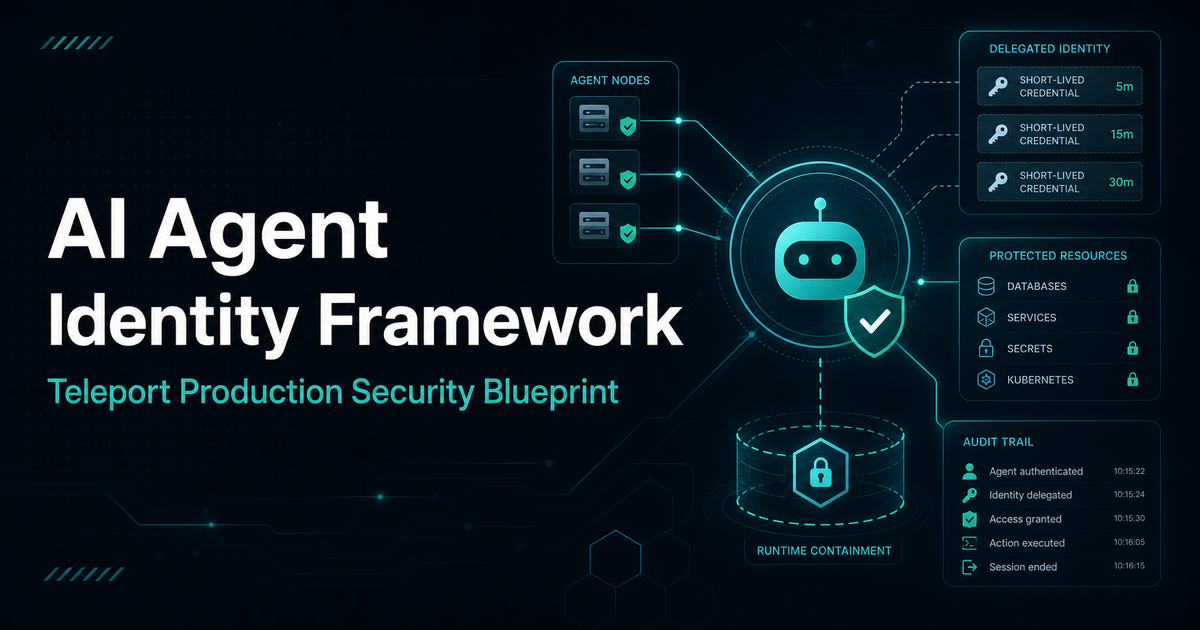
Production AI agents should not run on borrowed human tokens, static API keys, or broad service accounts. A useful AI agent identity framework gives every agent a short-lived identity, task-scoped authority, isolated runtime, model access controls, and an audit trail that connects prompts to infrastructure actions. I have found that most agent security discussions start too late. They inspect logs after the agent has already called a tool, touched a database, or opened a production shell. That is not enough once agents move from Slack demos into deployment workflows, incident response, data analysis, or infrastructure automation. ...

April 13, 2026 · 16 min · baeseokjae
AI Coding Agent Capability Matrix 2026

AI Coding Agent Capability Matrix 2026: MCP, HTTP Transport, Rules, Hooks, and Sandboxes Compared

The best AI coding agent in 2026 is no longer the one with the flashiest model demo. The practical difference is the harness: MCP transport, repo rules, hooks, sandbox policy, network controls, and how safely the agent can act without turning every task into a permission prompt. I’ve found that teams get into trouble when they compare Codex, Claude Code, Cursor, Copilot, Windsurf, Gemini CLI, Cline, Continue, and Aider as if they are just chat UIs wrapped around frontier models. They are not. They are developer runtimes. They read files, run commands, call tools, open browsers, use secrets, and sometimes push pull requests. That makes the agent harness the thing you should evaluate first. ...

April 13, 2026 · 18 min · baeseokjae
AI Coding Tool Data Privacy Comparison 2026

AI Coding Tool Data Privacy Comparison 2026: Trae Telemetry vs Open-Source vs Enterprise

AI coding tool privacy in 2026 comes down to three questions: what code context leaves your machine, who can use it for training, and whether telemetry can be audited or disabled. I’ve found that brand claims matter less than the actual architecture, contract terms, and default data flows. What Is the Short Answer for AI Coding Tool Privacy in 2026? If you are working on throwaway code, almost any AI coding assistant is acceptable as long as you do not paste secrets, tokens, customer data, or unreleased product logic into the prompt. If you are working on proprietary source code, the default should be stricter: use an enterprise plan with no-training commitments and admin controls, or use an open-source agent wired to a local or self-hosted model endpoint. ...

April 13, 2026 · 11 min · baeseokjae