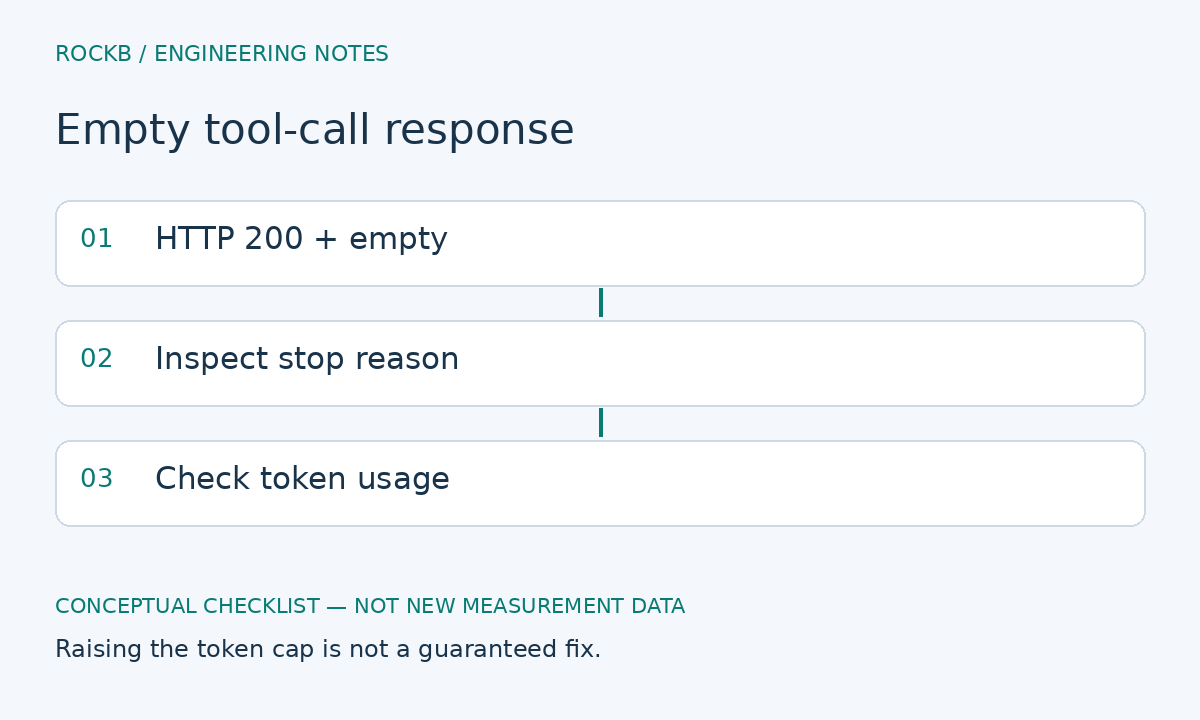
An agent sends a request with a tools array and a modest output cap. The server answers HTTP 200, the body parses, and the assistant message is empty: content is "", tool_calls is absent, and no error field explains it. The loop logs “model returned no content”, retries the identical request, and the next turn is empty in the same way. The operator starts suspecting the model, the quantisation or the chat template, because nothing in the client raised an exception.
The response already contains the diagnosis. Read the stop reason and the token count before anything else: done_reason is "length" on the native /api/chat surface, finish_reason is "length" through /v1/chat/completions, and eval_count (native) or usage.completion_tokens (compatible surface) equals the cap that was set. The cap fired while the model was still emitting its tool-call preamble. In the chat handler a parsed call is emitted when the parser closes it: it is attached to the streaming chunk that completed it, or to the aggregated non-streaming response once generation is over. A call still incomplete when generation ends is never emitted at all, because the final chunk carries only whatever text the parser was holding outside the call. So the partial call is dropped rather than returned, and the response looks like an ordinary completed turn with nothing in it.
That is the whole diagnostic, and it fits in one response. The rest of this article is the fixture that produced it, the server code path behind it, and a negative result that matters for the obvious fix: on this fixture, raising the cap from 8 to 64 tokens did not restore the call.
The fields that separate a truncated call from a finished turn
Both surfaces expose the same state with different names. The native handler returns done_reason and eval_count; the OpenAI-compatible handler maps max_tokens onto the same internal cap and returns finish_reason plus usage. The tools documentation for Ollama v0.20.3 shows the normal shapes of a streamed and a final /api/chat response, and the OpenAI-compatibility page lists max_tokens and tools as supported parameters.
| What to read | Native POST /api/chat | POST /v1/chat/completions |
|---|---|---|
| why generation stopped | done_reason | choices[0].finish_reason |
| tokens actually generated | eval_count | usage.completion_tokens |
| call present | message.tool_calls | message.tool_calls |
| the limit you set | options.num_predict | max_tokens |
Three combinations are worth memorising, because they lead to different actions:
lengthplus a token count equal to your cap: the cap fired. Any partial call was dropped. This is the case measured here.stopwith a non-emptycontentand notool_calls: the model answered in prose instead of calling a tool. Raising the cap will not change that.tool_callspresent: a call was parsed and returned. Whatever goes wrong after this is argument or client-side validation, not truncation.
The num_predict option is documented in the v0.20.3 Modelfile reference as the maximum number of tokens to predict, defaulting to -1 for unbounded generation. The cap in a failing request is therefore the caller’s own number, not a hidden model limit.
What the measured run shows
The fixture is deliberately small and boring: qwen2.5:0.5b (Q4_K_M, 397 MB, 4096-token context) on Ollama 0.20.3, one create_ticket tool schema with three required fields (title, priority as an enum, summary), temperature 0, seed 7. Two prompt variants were used: A with a long operator preamble and a detailed customer message, B with a one-sentence preamble and a short request. Caps of 8, 16, 24, 32, 40 and 48 tokens were requested on both variants and both API surfaces, five repetitions per cell, with one extra repetition in the native variant-A cell at cap 24 and one further cell at 64 on the native surface. The run recorded 129 requests in total. The table below counts every request per cap, so its rows already include the two native streaming cells at caps 16 and 48; the remaining 127 requests are the graded cells.
| Cap | Requests | Empty content, no tool_calls | Complete calls | Stop reason |
|---|---|---|---|---|
| 8 | 20 | 20 | 0 | length |
| 16 | 21 | 21 | 0 | length |
| 24 | 21 | 21 | 0 | length |
| 32 | 20 | 20 | 0 | length |
| 40 | 20 | 20 | 0 | length |
| 48 | 21 | 21 | 0 | length |
| 64 | 5 | 5 | 0 | length |
| 96 | 1 | 0 | 1 | stop |
Every request at caps 8 through 64 returned HTTP 200 with content of length zero, no tool_calls, and a stop reason of length. On the native surface eval_count equalled the cap in every one of those requests; on the compatible surface usage.completion_tokens equalled max_tokens in all 60 compatible requests. The empty message is not a client serialisation artefact: the same state appears in the raw JSON body, on both surfaces, with the token accounting that proves generation happened.
The single exception in the log is one request at 96 tokens on the native surface with variant A: a complete create_ticket call, done_reason "stop", eval_count 95. It is one observation, not a boundary. No repetition was made at 96, variant B was not tested there, and the compatible surface never reached a complete call inside the tested range. Treat it as evidence that the fixture can complete at a larger cap, not as a value to copy.
Why the content is empty rather than truncated
The intuitive model of a token cap is “the answer gets cut off”, and for plain text that is what happens: you receive a partial sentence. With a tools array the observable is different, because a partial tool call has nowhere to go in the response schema.
In the chat handler of server/routes.go at v0.20.3, the branch that runs when the request carries a tools array hands each chunk to the tool parser (toolCalls, content := toolParser.Add(res.Message.Content), line 2493). When the parser closes a call, that branch attaches the calls to the chunk that completed them and empties the content (res.Message.ToolCalls = toolCalls; res.Message.Content = "", lines 2496-2501). When it has not closed one, the final chunk carries whatever text the parser is still holding and nothing else - if r.Done { res.Message.Content = toolParser.Content(); ch <- res }, lines 2513-2515 - and a non-streaming call then attaches the collected calls only when at least one closed call was parsed: if len(toolCalls) > 0 { resp.Message.ToolCalls = toolCalls }, lines 2608-2610. A generation stopped at the cap still reports done, but an unterminated call never becomes an entry in that slice, so the attachment is skipped and the message goes out with empty content. (The older /api/generate path applies the same rule in GenerateHandler with a different field, if cr.Done && len(toolCalls) > 0 { res.ToolCalls = toolCalls } at lines 584-585; every measurement in this article is on the chat path, where /api/chat and the /v1/chat/completions wrapper are both served by ChatHandler.) The response that reaches the client is a normal completion carrying an empty content string and no tool_calls. Nothing in that payload is marked as an error, because from the server’s point of view nothing failed: the client’s limit was honoured exactly.
The compatible layer inherits the same shape. In openai/openai.go at v0.20.3, max_tokens is copied into the internal num_predict option, and for a non-streaming response the finish reason is rewritten to tool_calls only when the response actually carries tool calls; otherwise the underlying done_reason string is returned unchanged. Streaming applies the same rule in toChunk, which reports tool_calls when the chunk itself carries calls or when an earlier chunk already sent one (toolCallSent), so the rewrite tracks calls having been emitted rather than calls present in the final message alone. A dropped partial call therefore keeps finish_reason: "length" instead of being rewritten into something a client might notice.
This is why the failure is so quiet in an agent loop. A text-generation client that checks only for empty content can treat the turn as a no-op; a tool-calling client that checks only for tool_calls sees “no call” and often assumes the model chose not to act. The stop reason is the field that separates those cases, and it is present in every response.
The negative result: raising the cap did not fix it on this fixture
The obvious remedy is to raise the limit. On this fixture it did not work over an eightfold range. Twenty graded runs at 48 tokens - five per cell across the two prompt variants and the two surfaces - plus the one streaming request at that cap produced zero complete calls, and five runs at 64 on the native surface also produced zero. The first and only complete call in the log came at 96 tokens, in a single run.
Two readings of that result are tempting and both are wrong. The first is that 96 is the required cap; with n=1 and one variant it supports no such constant, and the same schema on another model or template will spend a different number of tokens before the call closes. The second is that the cap value is irrelevant, which over-reads a single model. What the run does establish is narrower and still useful: the empty state is stable from 8 to 64 tokens, so a retry loop that bumps the cap by a small increment will keep producing identical empty turns while burning time, and a diagnostic that relies on “it will work with a bigger number” has no measured basis here.
The practical consequence is to stop treating the cap as the variable to tune and treat the empty response as the signal to inspect. If the stop reason is length, the request needs a different shape - a shorter preamble, a smaller schema, or a generation budget sized to the template - not the same request submitted again with a larger number.
A check you can run on one response
The detection step needs no server logs and no framework instrumentation. Take the response object your client already has, pass in the cap you sent, and check the three fields together:
def capped_without_call(resp, cap, native=True):
    """cap is the limit you sent, not a field the server echoes back."""
    if native:
        reason, tokens = resp.get("done_reason"), resp.get("eval_count")
        message = resp.get("message") or {}
    else:
        choice = (resp.get("choices") or [{}])[0]
        reason, tokens = choice.get("finish_reason"), (resp.get("usage") or {}).get("completion_tokens")
        message = choice.get("message") or {}
    return (reason == "length"
            and not message.get("content")
            and not message.get("tool_calls")
            and cap is not None and tokens == cap)
cap is an argument because the response does not carry it. In api/types.go at v0.20.3, ChatResponse (line 534 onward) has no options field - Options is declared on ChatRequest (line 168) - and the compatible body exposes usage.completion_tokens but never max_tokens, so the limit has to come from the request you sent and be compared against the token count the server reports. Pass the num_predict value you set, or the max_tokens you passed to the wrapper; the two are the same number after the mapping described above.
The predicate is a reading aid, not a fix: it tells you that the cap fired and the call was dropped. Log done_reason, eval_count and the configured cap on every turn, not only on errors, so the state is visible the first time it happens rather than after a retry storm. When the predicate is true, do not resubmit the identical request; change the prompt or the budget first, or surface the state to the operator.
Two neighbours are worth reading alongside this one. The Ollama API integration guide covers the request and response fields this article relies on, and the function-calling guide explains finish_reason as the signal for detecting a call; this piece is the case where that signal reads length instead. For the prompt-side failure that looks similar but is not the same, the context-truncation diagnosis covers a prompt that is cut before generation starts, and the concurrent-session logging checklist already names length plus num_predict as the stop signal for text turns, though not for a discarded tool call. Readers running the same loop against a different engine can compare the parser behaviour in the vLLM streaming tool-call case, and the local agent guide covers the retry structure in which one empty turn becomes a stall.
Fixture, reproduction and limits
The run used two stdlib urllib scripts against the local daemon at 127.0.0.1:11434, no SDK. Each request recorded the HTTP status, wall time, content length, presence of tool_calls, JSON-parseability of the arguments and whether every required key was present, plus done_reason/finish_reason and eval_count/usage.completion_tokens. The graded table, the raw request log, the environment capture and the method note are kept with the draft as a private local author verification; they are not offered here as a downloadable dataset or a reusable harness, so no reader-access promise is made for those files. The fixture is described completely enough to rebuild: one model tag, one tool schema, two prompts, one sampling setting, and the caps listed above.
The limits are the honest part of this result. It is one host (2 vCPU, recorded load average 4.64 before the sweep and 3.47 and 2.73 at two in-run checkpoints), one model, one quantisation, one tool schema, two prompt variants, and 129 requests. Requests went to a shared local daemon rather than a dedicated server instance, so wall times are provenance only and no throughput or latency claim is drawn from them. The single 96-token completion is one run on one variant, and no boundary is asserted across variants or surfaces. Nothing here measures how often this happens across models, and no prevalence figure is implied. What is supported is the diagnostic: a length stop with a token count equal to the cap and an empty message is the signature of a capped generation whose partial tool call was discarded, and on this fixture raising the cap across an eightfold range did not restore the call.