Claude Code vs GitHub Copilot 2026

Claude Code vs GitHub Copilot 2026: Terminal Agent vs IDE Assistant

Claude Code and GitHub Copilot solve the same problem—writing better code faster—but they do it in fundamentally different ways. Claude Code is an autonomous terminal agent that operates on your entire codebase; Copilot is an IDE extension that sits beside you as you type. Choosing between them depends on how you actually work, not which has the longer feature list. What Is Claude Code and How Does It Work? Claude Code is Anthropic’s CLI-based coding agent. You run it from the terminal with claude and it can read files, run tests, execute shell commands, and make multi-file edits—all from a conversation loop. There’s no IDE plugin required. ...

April 14, 2026 · 10 min · baeseokjae
AI Agent Deployment Infrastructure 2026

AI Agent Deployment Infrastructure 2026: Ampere.sh vs E2B vs Modal vs Northflank

If you need an always-on managed assistant, Ampere.sh is the fastest path; if you need programmable, isolated coding workspaces, E2B usually fits better; if you need serverless GPU workflows plus sandbox primitives, Modal is often the best platform; and if you need BYOC, SOC 2 Type 2 posture, and one control plane for jobs, workers, APIs, and sandboxes, Northflank typically wins. I learned this the hard way while comparing these platforms for teams that moved from demo-only agent projects to production. The failure pattern is always the same: teams buy for one axis (for example “runs code in sandbox”), then discover they also need persistence, compliance, observability, or GPU jobs and the original choice breaks. This guide is written to prevent that category error. ...

April 13, 2026 · 11 min · baeseokjae
AI Agent Deployment Infrastructure 2026

AI Agent Deployment Infrastructure 2026: Ampere.sh, E2B, Northflank, and Modal Compared

AI agent deployment infrastructure in 2026 is not one category. Ampere.sh, E2B, Northflank, and Modal solve different problems: managed agent hosting, secure code execution, full-stack production infrastructure, and Python/GPU serverless compute. The right shortlist depends on what your agent actually does after the model call returns. I’ve found that teams get into trouble when they compare these platforms as if they were four interchangeable “agent sandbox” vendors. They are not. A personal OpenClaw agent that needs to stay online in a managed product has little in common with a coding agent that needs Firecracker isolation for 20 concurrent Python sessions. A regulated enterprise deploying agents near private data has different constraints again. And if your agent is mostly a Python inference pipeline wrapped in tool calls, Modal may be closer to the center of gravity than a dedicated sandbox API. ...

April 13, 2026 · 14 min · baeseokjae
AI Agent Identity Framework: Teleport's Production Security Blueprint

AI Agent Identity Framework: Teleport's Production Security Blueprint

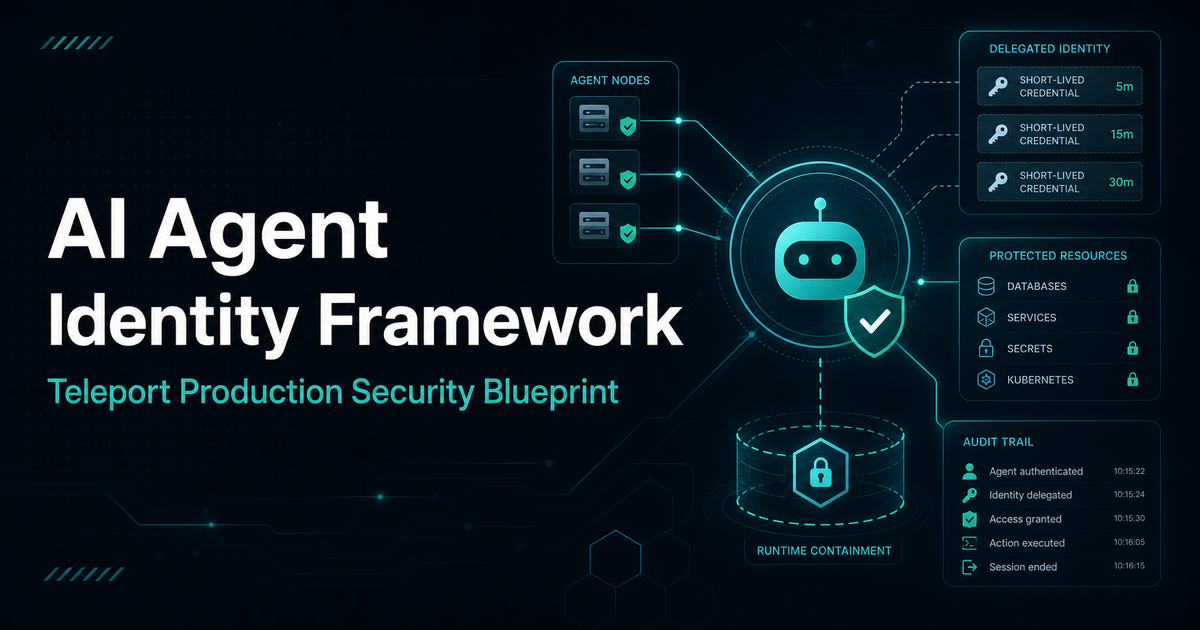
Production AI agents should not run on borrowed human tokens, static API keys, or broad service accounts. A useful AI agent identity framework gives every agent a short-lived identity, task-scoped authority, isolated runtime, model access controls, and an audit trail that connects prompts to infrastructure actions. I have found that most agent security discussions start too late. They inspect logs after the agent has already called a tool, touched a database, or opened a production shell. That is not enough once agents move from Slack demos into deployment workflows, incident response, data analysis, or infrastructure automation. ...

April 13, 2026 · 16 min · baeseokjae
AI Coding Agent Capability Matrix 2026

AI Coding Agent Capability Matrix 2026: MCP, HTTP Transport, Rules, Hooks, and Sandboxes Compared

The best AI coding agent in 2026 is no longer the one with the flashiest model demo. The practical difference is the harness: MCP transport, repo rules, hooks, sandbox policy, network controls, and how safely the agent can act without turning every task into a permission prompt. I’ve found that teams get into trouble when they compare Codex, Claude Code, Cursor, Copilot, Windsurf, Gemini CLI, Cline, Continue, and Aider as if they are just chat UIs wrapped around frontier models. They are not. They are developer runtimes. They read files, run commands, call tools, open browsers, use secrets, and sometimes push pull requests. That makes the agent harness the thing you should evaluate first. ...

April 13, 2026 · 18 min · baeseokjae
AI Coding Tool Data Privacy Comparison 2026

AI Coding Tool Data Privacy Comparison 2026: Trae Telemetry vs Open-Source vs Enterprise

AI coding tool privacy in 2026 comes down to three questions: what code context leaves your machine, who can use it for training, and whether telemetry can be audited or disabled. I’ve found that brand claims matter less than the actual architecture, contract terms, and default data flows. What Is the Short Answer for AI Coding Tool Privacy in 2026? If you are working on throwaway code, almost any AI coding assistant is acceptable as long as you do not paste secrets, tokens, customer data, or unreleased product logic into the prompt. If you are working on proprietary source code, the default should be stricter: use an enterprise plan with no-training commitments and admin controls, or use an open-source agent wired to a local or self-hosted model endpoint. ...

April 13, 2026 · 11 min · baeseokjae
API vs MCP Difference in 2026

API vs MCP Difference in 2026: What AI Agent Developers Should Actually Use

The API vs MCP difference is simple: APIs expose product capabilities, while MCP standardizes how AI agents discover and use those capabilities. In 2026, I would not treat MCP as an API replacement. I would treat it as an agent integration layer that sits beside well-designed REST, GraphQL, gRPC, or internal service APIs. Why are developers debating API-first vs MCP in 2026? Most teams already have APIs. They have OpenAPI specs, service ownership, auth middleware, rate limits, API gateways, Postman collections, SDKs, and dashboards. That investment is not going away because agents showed up. ...

April 13, 2026 · 17 min · baeseokjae
Cursor vs Windsurf vs Zed: Best AI IDE in 2026?

Cursor vs Windsurf vs Zed: Best AI IDE in 2026?

Pick the wrong AI IDE and you’ll ship 3–5x slower than developers who picked the right one. In 2026, the market has consolidated around three distinct tools — Cursor, Windsurf, and Zed — each with radically different philosophies. This comparison digs into real benchmarks, pricing structures, and Claude Code integration to help you decide. Why Does Your AI IDE Choice Matter So Much? AI coding tools have moved past the experimental phase, and the performance gap is now quantifiable: research shows developers using the right AI IDE ship features 3–5x faster than those on the wrong one, a difference that compounds across sprints into a decisive competitive advantage for engineering teams. That gap doesn’t come from autocomplete quality or UI polish. It comes from agentic autonomy, codebase understanding depth, and workflow fit—three dimensions where Cursor, Windsurf, and Zed diverge sharply despite all three positioning themselves as AI-first editors. The wrong choice means paying a $20–$200/month subscription for capabilities that don’t match how your team actually codes, while the right choice reconfigures how you approach complex refactors, multi-file edits, and real-time collaboration. ...

April 13, 2026 · 14 min · baeseokjae
GitHub Copilot AI Cost Centers

GitHub Copilot AI Cost Centers: 2026 Guide to Budget Controls

GitHub Copilot AI cost centers are now the practical control plane for usage-based Copilot billing. Since June 1, 2026, Business and Enterprise customers need to manage pooled AI Credits, metered overage, user-level budgets, and cost-center limits together instead of treating Copilot as a flat per-seat tool. What Changed With GitHub Copilot Billing In 2026? GitHub moved Copilot Business and Copilot Enterprise usage-based billing to GitHub AI Credits on June 1, 2026. The seat prices stayed the same: $19 per user per month for Copilot Business and $39 per user per month for Copilot Enterprise. The important change is that many higher-cost Copilot features now draw from a monthly pool of included credits, then move into paid metered usage if your configuration allows it. ...

April 13, 2026 · 14 min · baeseokjae
Google Agent Quality Flywheel Skill Guide 2026

Google Agent Quality Flywheel Skill Guide 2026: Testing and Grading Agents

A Google agent quality flywheel skill is a reusable workflow that turns agent traces into graded eval cases, runs them locally and in CI, then feeds production failures back into the test suite. For coding agents, the goal is simple: stop trusting “done” and start checking behavior, tool use, and real state changes. What is a Google agent quality flywheel skill? The phrase “Google agent quality flywheel skill” is not an official Google product name. I use it as a practical pattern for teams building agents with Google Agent Development Kit (ADK), Vertex AI Gen AI Evaluation, and a coding agent that can maintain its own eval suite. ...

April 13, 2026 · 15 min · baeseokjae