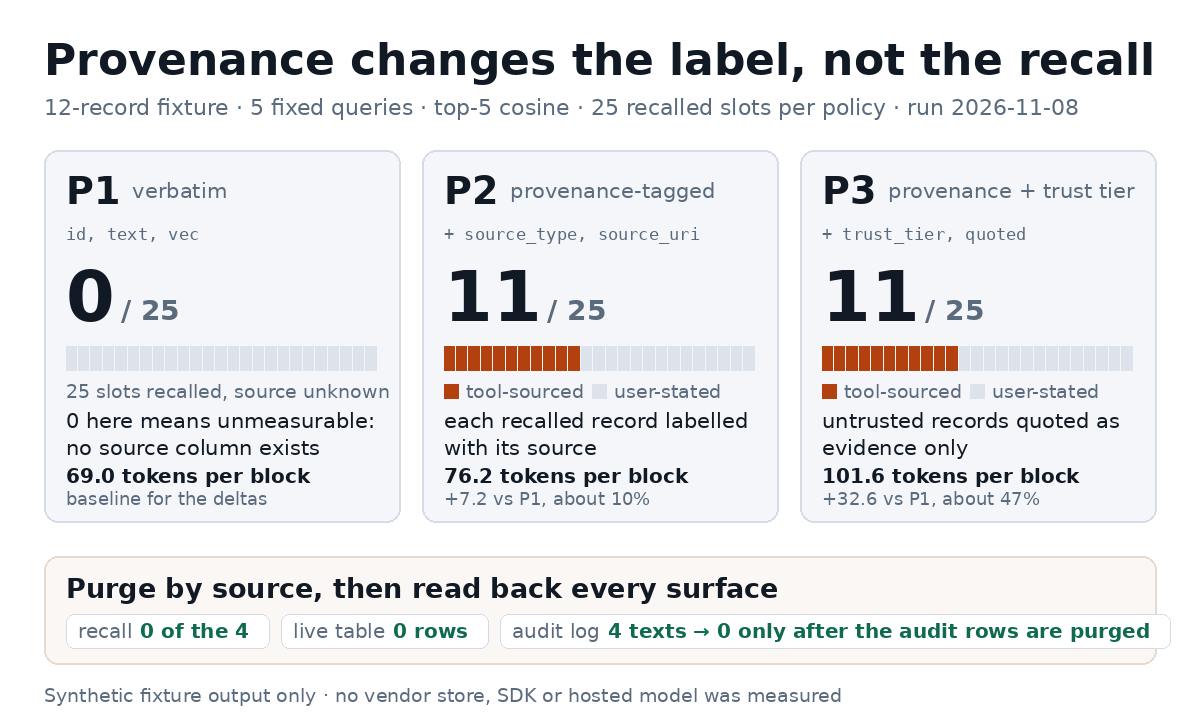
Diagram of one measured fixture, three write policies. P1 verbatim recalls 25 of 25 slots but cannot attribute any of them because the store has no source column, at 69.0 whitespace tokens per assembled block. P2 provenance-tagged recalls the same 25 slots and labels 11 of them as tool-sourced, at 76.2 tokens. P3 adds a trust tier and quotes untrusted records as evidence, also labelling 11 of 25, at 101.6 tokens. A lower strip shows the purge-by-source read-back: recall 0 of the 4 purged records, live table 0 rows, audit log still returning 4 texts until the audit rows themselves are purged. Conceptual diagram of fixture output, not a vendor benchmark.

Agent Memory Provenance: can you tell a tool-fetched fact from a user's?

An agent writes to long-term memory from two channels: what the user said, and what a tool returned. A ticket comment, a PDF, a fetched runbook page and the user’s own sentence all arrive as strings, and the extraction step turns each into a fact. The store usually keeps the fact. Most schemas do not keep the channel. That produces a question an operator cannot answer from the store: of the memories assembled into this prompt, which ones came from outside the trust boundary? And its operational twin: when the page turns out to be wrong, can I purge everything that came from that URL and prove the purge worked? ...

November 8, 2026 · 10 min · baeseokjae