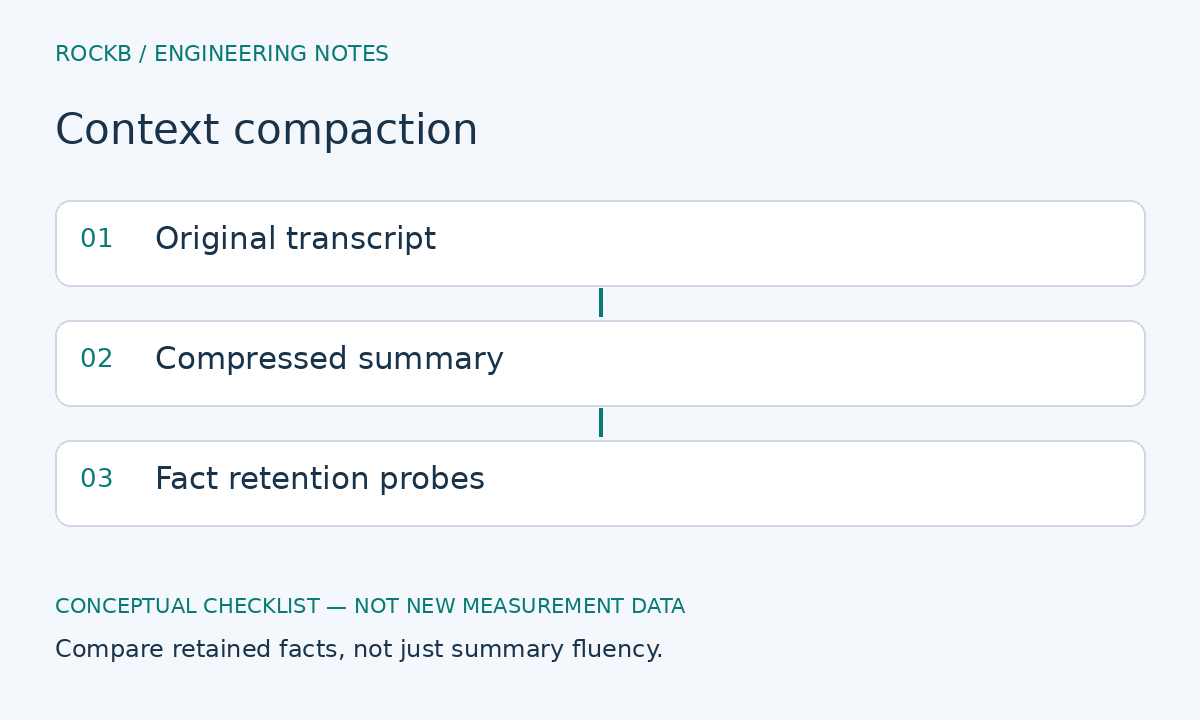
Conceptual checklist for context compaction: Original transcript, then Compressed summary, then Fact retention probes. Compare retained facts, not just summary fluency.

Agent Context Compaction: What Gets Lost—and How to Test It

An agent works for two hours. The harness compacts the transcript, the run continues, and somewhere in the next twenty turns it re-runs a migration it has already run, asks the user for a value the user typed an hour ago, or refactors a file it was explicitly told not to touch. Nothing in the run log marks the turn where that fact disappeared. The summary reads fluently, the task still finishes, and the only trace of the loss is work the agent repeats. ...
November 2, 2026 · 11 min · baeseokjae
Agent Walking-Dead State Detection: How to Detect and Patch Stalled AI Agents

Agent Walking-Dead State Detection: How to Detect and Patch Stalled AI Agents

A “walking-dead” AI agent is a process that keeps running, consuming tokens and passing every liveness check, while producing no durable progress toward its task. You detect it not by watching whether the process is alive, but by tracking whether its work actually advances. In one documented case, a SWE-bench Verified agent stayed busy until it used 1.06 million tokens—inspecting, reasoning, and calling tools—yet never wrote the patch, and every health check reported it healthy. This guide shows you how to detect walking-dead states, separate liveness from progress, and patch stalled agents before they burn your budget. ...

September 23, 2026 · 11 min · baeseokjae
Deterministic Agent Loop Failures 2026

Deterministic Agent Loop Failures 2026: Why Your AI Agent Keeps Repeating Itself

Your AI agent is stuck in a loop. It tried the same API call three times, got the same 503, and it’s about to try a fourth. The log looks like a broken record. This is a deterministic agent loop failure — and it’s the single most common reason production agent deployments fail in 2026. I’ve been running autonomous agents in production for the past year, and loop failures are the problem that keeps coming up. Not model quality, not prompt engineering — agents that get stuck repeating the same failing action until they burn through their token budget or hit a hard timeout. The frameworks that work in demos break in production because they treat the LLM as a reliable component. It isn’t. Here’s what I’ve learned about why loops happen and how to actually fix them. ...

July 13, 2026 · 12 min · baeseokjae