DryRun Security Review 2026: AI SAST Built for Agentic Coding Workflows

DryRun Security Review 2026: AI SAST Built for Agentic Coding Workflows

DryRun Security is an AI-native SAST platform built specifically for teams shipping code with AI agents. Unlike traditional scanners that match patterns, it understands behavior — detecting logic-level flaws that Snyk, Semgrep, and CodeQL routinely miss. What Is DryRun Security? (AI-Native SAST for the Agentic Era) DryRun Security is an AI-powered Static Application Security Testing (SAST) platform designed from the ground up for agentic and AI-assisted coding workflows. Founded to address a specific failure mode — that traditional pattern-matching scanners cannot reason about code behavior, only code structure — DryRun built its Contextual Security Analysis (CSA) engine around large language models that understand intent, data flow, and business logic. In March 2026, DryRun published research showing 87% of AI agent pull requests (26 of 30 sampled) introduced at least one security vulnerability, and their CSA engine detected 88% of all seeded vulnerabilities in head-to-head testing — a figure that dropped below 40% for every competitor tested. DryRun earned a 4.9/5 rating on G2 and was named a High Performer in SAST in Spring 2026 G2 Reports. For teams running Claude Code, Cursor, or Windsurf, DryRun embeds directly into the IDE via its Code Insights MCP server, surfacing security findings before a PR is even opened. ...
May 18, 2026 · 15 min · baeseokjae
Claude Mythos Cybersecurity Guide 2026: Zero-Day Detection and Project Glasswing Explained

Claude Mythos Cybersecurity Guide 2026: Zero-Day Detection and Project Glasswing Explained

Claude Mythos is Anthropic’s most advanced AI security model, achieving a 73% success rate on expert-level CTF tasks and identifying thousands of zero-day vulnerabilities across every major OS and browser before its April 2026 release. Access is gated through Project Glasswing, a vetted defensive coalition of 12 named partners including Microsoft, Google, and CrowdStrike, plus 40+ critical infrastructure organizations. What Is Claude Mythos Preview? (And Why Anthropic Kept It Secret) Claude Mythos Preview is Anthropic’s frontier cybersecurity model — a purpose-built AI system that autonomously discovers, analyzes, and proves exploitability of software vulnerabilities at a capability level no model had reached before April 2025. Unlike Claude Opus or Sonnet, which are general-purpose assistants, Mythos was trained specifically to perform security research tasks: reading source code across millions of lines, forming hypotheses about vulnerable code paths, writing proof-of-concept exploits, and iterating until a working attack chain is confirmed. The model was kept in restricted preview for over a year before its April 7, 2026 announcement because Anthropic’s internal red teams confirmed it could assist with real-world offensive operations — including completing a 32-step corporate network attack simulation that human experts estimate would take 20 hours, in 3 of 10 controlled attempts. The decision to restrict rather than broadly release the model reflects Anthropic’s Responsible Scaling Policy: Mythos crossed an internal threshold requiring mandatory containment measures before any external access. The result is a model that is simultaneously the most powerful defensive security tool ever deployed at scale and one of the most carefully gated AI releases in the industry’s history. ...

May 17, 2026 · 18 min · baeseokjae
Cisco AI Defense Review 2026: Security for AI Agents and LLM Applications

Cisco AI Defense Review 2026: Security for AI Agents and LLM Applications

Cisco AI Defense is the enterprise platform that secures AI agents and LLM applications by enforcing security at the network level — without requiring code changes from developers. If you’re an engineering or security team deploying agentic AI in 2026, this is the most comprehensive platform on the market for addressing the full attack surface: model vulnerabilities, prompt injection, MCP protocol abuse, agent-to-agent trust chains, and AI supply chain transparency. ...

May 15, 2026 · 19 min · baeseokjae
Microsoft Agent Governance Toolkit: Open-Source Runtime Security for AI Agents

Microsoft Agent Governance Toolkit: Open-Source Runtime Security for AI Agents

Released on April 2, 2026, the Microsoft Agent Governance Toolkit is the first open-source runtime security framework to address all ten risks on the OWASP Agentic AI Top 10. Shipped under the MIT license, it provides deterministic policy enforcement at the agent action layer with less than 5ms overhead per evaluated action. As the agentic AI security market grows from a projected $1.65 billion in 2026 toward an estimated $13.52 billion by 2032 at roughly 42% CAGR, this toolkit arrives at exactly the moment enterprises need a vendor-neutral, community-owned standard for governing what their AI agents are actually permitted to do. ...

May 15, 2026 · 19 min · baeseokjae
AWS Frontier Agents Review 2026: AI-Powered Security Testing and DevOps

AWS Frontier Agents Review 2026: AI-Powered Security Testing and DevOps

AWS Frontier Agents reached general availability on March 31, 2026, marking the most significant expansion of Amazon’s AI portfolio since Bedrock launched in 2023. Two production-ready agents — the AWS Security Agent and the AWS DevOps Agent — are now available to all AWS customers, backed by Amazon Bedrock and powered by Claude models from Anthropic. This review covers architecture, performance benchmarks, competitive positioning against Azure AI Agent Service and Google Cloud Agent Builder, and a practical deployment guide so you can get Frontier Agents running in your own pipeline today. ...

May 15, 2026 · 17 min · baeseokjae
LLM Red Teaming Guide: Scope, Failure Evidence and Regression Cases

LLM Red Teaming Guide: Scope, Failure Evidence and Regression Cases

An LLM red-team exercise is useful when it reveals a failure you can reproduce, explain and fix. Collecting dramatic prompts without an application boundary or an outcome definition produces little evidence about a deployed agent. This guide focuses on authorized testing of systems you own or have permission to assess. It provides a runbook and result schema, not a claimed security score for a model or product. Define the trust boundary OWASP’s prompt-injection description covers adversarial instructions entering through prompts or external content. Its prevention guidance recommends layered controls instead of treating natural-language instructions as an authorization system. ...

May 10, 2026 · 3 min · baeseokjae
OpenAI Acquires PromptFoo: What It Means for AI Security Testing in 2026

OpenAI Acquires PromptFoo: What It Means for AI Security Testing in 2026

OpenAI acquiring PromptFoo is not a talent grab — it is a strategic acknowledgment that AI security testing is no longer optional infrastructure. With 93% of organizations now shipping AI-generated code and only 12% applying equivalent security standards, the attack surface is enormous and growing. PromptFoo was the most mature open-source tool purpose-built for LLM red-teaming, and OpenAI buying it means the company is betting that security evaluation needs to be a first-class part of the developer workflow, not an afterthought bolted on by a third-party CLI. ...

May 10, 2026 · 13 min · baeseokjae
DAST Tools Comparison 2026: Top 10 AI-Powered Dynamic Security Testing Tools

DAST Tools Comparison 2026: Top 10 AI-Powered Dynamic Security Testing Tools

The best DAST tool for 2026 depends on your stack: Invicti leads on accuracy (99.98% proof-based), Bright Security is the top pick for AI/LLM app security with under 3% false positives, StackHawk wins for developer-centric CI/CD integration, and OWASP ZAP remains the strongest free option. This breakdown covers all ten. What Is DAST and Why AI Makes It Critical in 2026 Dynamic Application Security Testing (DAST) is the practice of probing a running application — sending real HTTP requests, manipulating inputs, and observing responses — to discover vulnerabilities that static analysis cannot find. Unlike SAST, which reads source code, DAST interacts with the app the same way an attacker would: through its live interfaces. In 2026, this matters more than ever because the DAST market was valued at USD 3.57 billion in 2025 and is projected to reach USD 11.02 billion by 2032 at a 17.5% CAGR, driven by API proliferation, AI-generated code vulnerabilities, and DevSecOps mandates. Only 44% of security teams currently use DAST tools despite the need being acute — which means the majority of organizations are shipping web apps and APIs without runtime security validation. ...

May 7, 2026 · 20 min · baeseokjae
RockB editorial guides

Cursor Bugbot Review 2026: Coverage, Rollout, CodeQL and Multi-Repo Billing

Bugbot reviews the pull-request diff and reports bugs, security issues and code-quality problems, with an explanation and a suggested fix for each finding. Everything a buyer needs to decide on it follows from how that sentence is scoped, and the documentation answers the four procurement questions unevenly: coverage is partly built in and partly written as rules, rollout is one access grant on GitHub but a per-repository toggle on four other hosts, Bugbot is not a CodeQL replacement, and billing is now per run rather than per seat. ...

May 3, 2026 · 11 min · baeseokjae
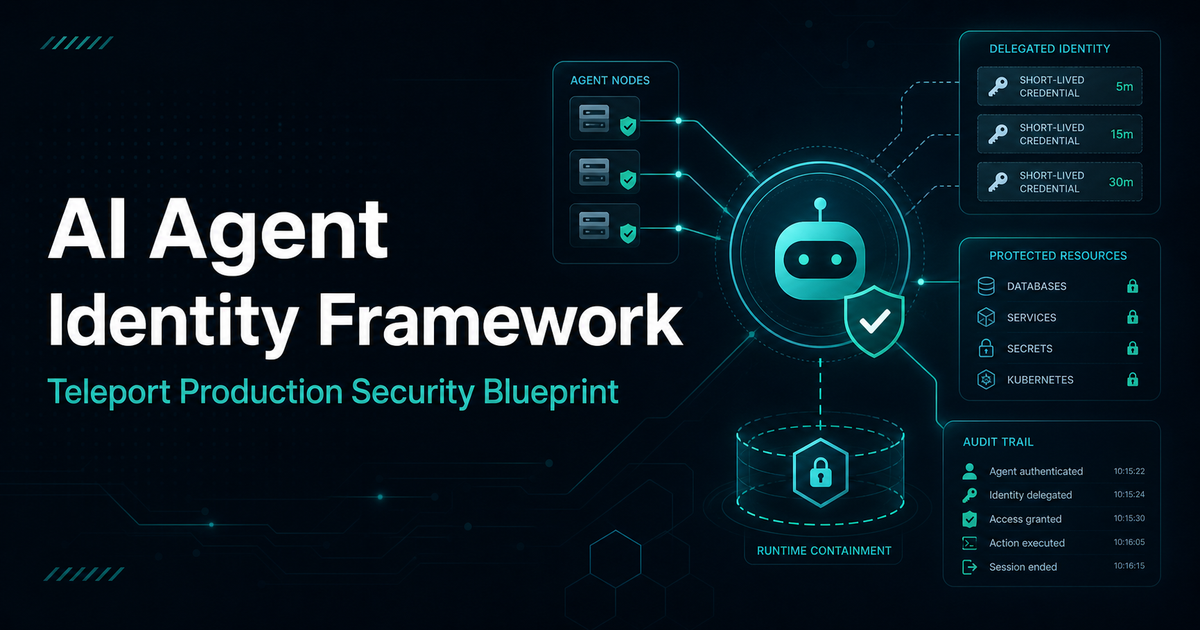
AI Agent Identity Framework: Teleport's Production Security Blueprint

AI Agent Identity Framework: Teleport's Production Security Blueprint

Production AI agents should not run on borrowed human tokens, static API keys, or broad service accounts. A useful AI agent identity framework gives every agent a short-lived identity, task-scoped authority, isolated runtime, model access controls, and an audit trail that connects prompts to infrastructure actions. I have found that most agent security discussions start too late. They inspect logs after the agent has already called a tool, touched a database, or opened a production shell. That is not enough once agents move from Slack demos into deployment workflows, incident response, data analysis, or infrastructure automation. ...

April 13, 2026 · 16 min · baeseokjae