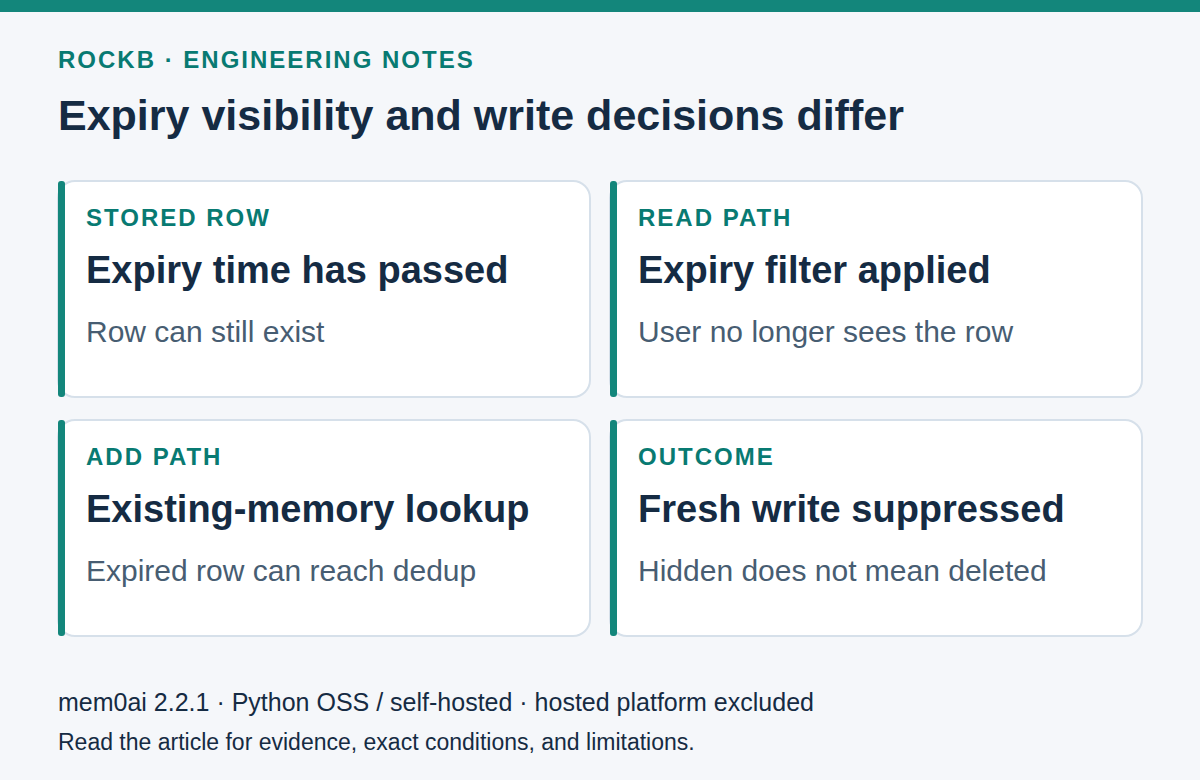
The read/write asymmetry described for self-hosted mem0ai 2.2.1: an expired row can be hidden by reads yet remain available to the write-path duplicate check. The hosted platform is excluded.

mem0 Expired Memories: Why New Writes Get Blocked

Your agent stored user prefers aisle seats with an expiration date. The date passed. The user says it again. You call add() with a fresh expiration_date, get no exception, get an empty results list, and get_all() shows nothing. The fact never lands, and it will never land as long as the expired copy is what the search returns. On mem0ai 2.2.1 — the Python OSS package, self-hosted — the cause is a read/write asymmetry. Expiration is applied as a filter on the read paths but not on the ADD path. The expired row is still handed to the extraction LLM as an “existing memory”, and its hash is still loaded into the dedup set, so the fresh write is dropped as a duplicate of a record the user can no longer see. The same write machinery adds a second dependency: an update that only touches metadata or the expiry date still calls the embedding provider, and a provider error stops that update before anything is persisted. ...
October 28, 2026 · 13 min · baeseokjae
ContextNest vs Mem0 vs Zep: Anatomy of Persistent Memory for AI Agents

ContextNest vs Mem0 vs Zep: Anatomy of Persistent Memory for AI Agents

ContextNest vs Mem0 vs Zep is the wrong framing: these three are complementary layers of the same memory stack, not competing products. Zep provides session log memory, Mem0 handles personalization memory, and ContextNest governs corporate knowledge — and production agents typically need all three. A single memory database is the most common architectural pitfall, because it cannot serve session continuity, user personalization, and compliance-ready knowledge at the same time. This guide dissects each layer, compares them head-to-head, and shows how to stack them. ...

August 24, 2026 · 13 min · baeseokjae
Mem0 vs Zep in Production: Choosing the Right AI Agent Memory Framework

Mem0 vs Zep in Production: Choosing the Right AI Agent Memory Framework

Mem0 is the right choice when you need broad framework integrations and chatbot personalization at scale; Zep is better when your agents must reason about relationships and time — and its graph memory costs 90% less than Mem0’s equivalent tier. Mem0 vs Zep at a Glance: Quick Comparison Table Mem0 and Zep are the two dominant AI agent memory frameworks in 2026, but they solve different problems. Mem0 (51,800+ GitHub stars, Apache 2.0, $24M Series A) is a semantic memory layer that extracts facts from conversations and stores them in a dual-store of vector embeddings plus an optional knowledge graph. Zep is a temporal knowledge graph engine built around Graphiti — a purpose-built system where time is a first-class dimension. On the LongMemEval benchmark, Zep scores 63.8% vs Mem0’s 49.0% using GPT-4o, a 15-point advantage concentrated in tasks that require tracking how facts change over time. Mem0 counters with 21 framework integrations (CrewAI, Flowise, Langflow, AWS Strands), 14 million Python package downloads, and 186 million API calls processed in Q3 2025 alone — numbers that reflect genuine production adoption at Netflix, Lemonade, and Rocket Money. ...

May 18, 2026 · 15 min · baeseokjae
Mem0 Guide 2026: Add Persistent Memory to Your AI Agents

Mem0 Guide 2026: Add Persistent Memory to Your AI Agents

AI agents without persistent memory lose 80% of context between interactions — every session starts cold, the agent has no recollection of user preferences, past decisions, or accumulated knowledge, and users pay both in frustration and in token costs. Mem0 solves this with a managed memory layer that combines vector search, knowledge graph storage, and key-value caching into a single API. With ~48,000 GitHub stars, a $24M Series A closed in October 2025, and YC backing, Mem0 has become the default choice for teams that want to bolt production-grade memory onto an existing agent in under a day. This guide covers everything you need to go from zero to a memory-enabled agent: architecture internals, quick start code, memory scoping patterns, integration with LangChain and AutoGen, pricing tiers, and how Mem0 compares to Zep and LangGraph Store. ...

May 7, 2026 · 16 min · baeseokjae
AI Agent Memory Architecture Guide 2026: Mem0, Zep, LangGraph Store Compared

AI Agent Memory Architecture Guide 2026: Mem0, Zep, LangGraph Store Compared

Zep scores 63.8% versus Mem0’s 49.0% on the LongMemEval benchmark — a 15-point gap that comes entirely from Zep’s temporal knowledge graph tracking when facts were true and when they changed. Mem0 has 48,000 GitHub stars, a $24M Series A, and the broadest standalone memory API. Letta raised $10M at a $70M valuation with Jeff Dean backing, building OS-inspired tiered memory where agents control their own context. Adding a memory context layer to a Snowflake data agent produced 20% accuracy improvement and 39% fewer tool calls. These numbers explain why agent memory architecture is now a first-class infrastructure decision — not an afterthought. Here’s how the major approaches compare and which to use. ...

May 7, 2026 · 13 min · baeseokjae
Best AI Agent Memory Frameworks in 2026: Mem0 vs Zep vs Letta Compared

Best AI Agent Memory Frameworks in 2026: Mem0 vs Zep vs Letta Compared

AI agents without persistent memory are stateless scripts — they forget every conversation, repeat themselves, and can’t personalize across sessions. In 2026, the agent memory ecosystem has matured enough that your choice of framework directly determines whether your agent can recall facts from six months ago, track how a user’s preferences changed over time, or accumulate institutional knowledge across thousands of interactions. Mem0 leads on community adoption (~48K GitHub stars), Zep leads on benchmark accuracy (63.8% LongMemEval vs Mem0’s 49.0%), and Letta offers a fundamentally different OS-inspired architecture that lets agents manage their own memory like RAM and disk. This guide compares all three in depth — plus Cognee, LangMem, and Hindsight — so you can pick the right tool for your use case. ...

April 15, 2026 · 17 min · baeseokjae