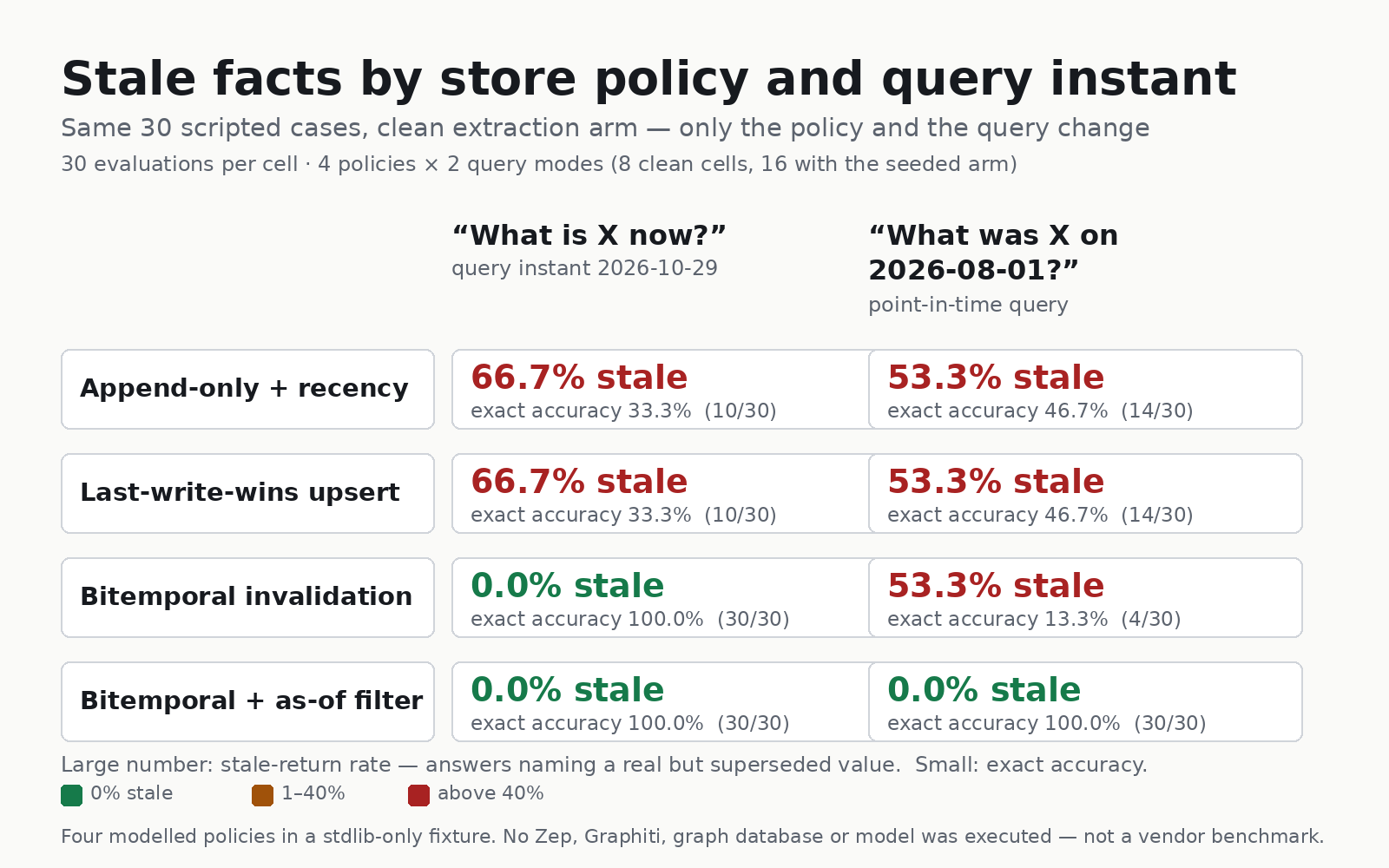
Table of stale-return rates from the 30-case fixture: append-only recency and last-write-wins upsert return a superseded value in 66.7% of current-truth queries, both bitemporal policies return none, and without a query-time as-of predicate the bitemporal store answers only 13.3% of 2026-08-01 queries correctly.

Zep Temporal Memory and Stale Facts: A Reproducible 30-Case Fixture (2026)

An agent answers “your plan is the Starter tier” three weeks after the account moved to Enterprise. The fact is in the store. The store has timestamps. The answer is still wrong. When that happens the team usually has three suspects and no way to tell them apart: the extraction step filed something incorrectly, the store’s invalidation rule never closed the old fact, or the retrieval query asked the wrong question. This post is a fixture that splits those three apart on paper and in code, so you can tell which one you are looking at. To be precise about the scope: what the fixture exercises is four modelled invalidation policies, not Zep or Graphiti themselves — neither product is run anywhere below. The governance version of the same argument is in the anatomy of persistent memory; this post is the measurement that argument does not carry. ...
October 30, 2026 · 10 min · baeseokjae
ContextNest vs Mem0 vs Zep: Anatomy of Persistent Memory for AI Agents

ContextNest vs Mem0 vs Zep: Anatomy of Persistent Memory for AI Agents

ContextNest vs Mem0 vs Zep is the wrong framing: these three are complementary layers of the same memory stack, not competing products. Zep provides session log memory, Mem0 handles personalization memory, and ContextNest governs corporate knowledge — and production agents typically need all three. A single memory database is the most common architectural pitfall, because it cannot serve session continuity, user personalization, and compliance-ready knowledge at the same time. This guide dissects each layer, compares them head-to-head, and shows how to stack them. ...

August 24, 2026 · 13 min · baeseokjae